

Analog Devices, Inc. announced today a pair of highly integrated 16-channel digital-to-analog (D/A) converters that significantly reduce the system footprint for wired telecommunications systems, yet without any performance compromise. The 12-bit AD5767 and 16-bit AD5766 are fully integrated devices with all the required bias ranges for coherent optical systems of medium- to long-haul, fiber-based telecommunication […]
Data Converters
A/D converter supports IF sampling of signals up to 9 Ghz for 4G/5G basestations
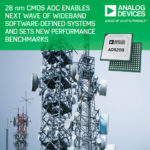
As part of a new series of high-speed analog-to-digital converters (A/D converters), Analog Devices, Inc. (ADI) today introduced the AD9208. Engineered for gigahertz-bandwidth applications, this A/D converter meets the increased spectral efficiency demands of 4G/5G multi-band wireless communications base stations. It also meets the reduced run-time targets of multi-standard production instrumentation and provides greater detection […]
Top analog threads on EDAboard.com – February
(editor’s note: Intrigued by the problem? Have a question or another solution? Then click the “Read more” link and follow the conversation on EDAboard.com or log in to EDAboard and participate in the analog IC forum threads.) Making gain positive and NF less than 7.0 dB – I have designed a mm-wave amplifier, as I intend to […]
What is a CODEC?
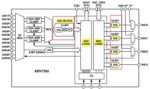
In the embedded hardware world, the term CODEC stands for COder/DECoder and is basically an analog-to-digital converter (ADC) and a digital-to-analog converter (DAC) in one package. A codec, whether hardware or emulated in software, converts analog audio signals into digital signals for transmission or encodes them for storage in a digital format. Later, the decoder […]
ADC resolution, accuracy, repeatability, and throughput
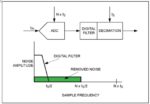
Here, we review some common specifications for successive approximation register (SAR) and sigma delta analog to digital converters (ADCs.) For converters, resolution is the number of bits per conversion cycle that the converter is capable of processing. For example, a converter with 12 bits of resolution is often referred to as “12 bits wide,” since […]
The 10 most popular posts on Analog IC Tips for 2016
We went into our article archives to uncover the most widely read posts on analogictips.com over the past 12 months. Here for your reading (or re-reading?) pleasure are the top 10 stories: How IoT and mixed signal designs will drive SiP tech in 2016 How much math do you need to know to design electronics? […]
SAR 16-bit ADC digitizes up to up to 750 kHz
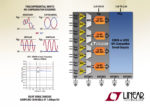
Linear Technology Corporation introduces the LTC2320-16, a 16-bit 1.5Msps per channel, no latency successive approximation register (SAR) ADC with eight simultaneously sampling channels supporting a rail-to-rail input common mode range. The LTC2320-16 features a flexible analog front end that accepts fully differential, unipolar or bipolar analog input signals, as well as arbitrary input signals, and […]
High-resolution, low-power SAR ADC lengthen operating time of instrumentation
Analog Devices today announced a new generation of high-precision successive-approximation (SAR) analog-to-digital converters (ADCs) that uniquely combine the attributes of high performance, low power, small footprint, and ease of use. These ICs enable mobile test and measurement instruments to operate for longer duration during field tests while improving measurement accuracy and repeatability. The new devices […]
Low power AFE targets wearable devices

Analog Devices, Inc. today announced a low power, next-generation biopotential analog front end (AFE) which enables smaller, lighter, and less obtrusive cardiac monitoring devices with longer battery life. The AD8233 AFE is a fully integrated, single-lead electrocardiogram (ECG) front end designed in one compact, easy-to-use component. Typically, developers need to design ECG front ends from […]
DAC offers high resolution with low component count for diverse applications

Analog Devices, Inc. today introduced the AD9164 D/A converter that brings high-resolution radar images for designers of military and commercial radar while reducing solution component count. Additionally, for designers of precision instrumentation equipment, such as smartphone testers, the new device ensures improved accuracy as well as speed of test, contributing to faster market-ready time while […]
