
• Skip to primary navigation
  • Skip to main content
  • Skip to primary sidebar
  • Skip to footer

Analog IC Tips

Analog IC Design, Products, Tools Layout

  • Products
    • Amplifiers
    • Clocks & Timing
    • Data Converters
    • EMI/RFI
    • Interface & Isolation
    • MEMS & Sensors
  • Applications
    • Audio
    • Automotive/Transportation
    • Industrial
    • IoT
    • Medical
    • Telecommunications
    • Wireless
  • Learn
    • eBooks / Tech Tips
    • FAQs
    • EE Learning Center
    • EE Training Days
    • Tech Toolboxes
    • Webinars & Digital Events
  • Resources
    • Design Guide Library
    • Digital Issues
    • Engineering Diversity & Inclusion
    • LEAP Awards
    • Podcasts
    • White Papers
  • Video
    • EE Videos
    • Teardown Videos
  • EE Forums
    • EDABoard.com
    • Electro-Tech-Online.com
  • Engineering Training Days
  • Advertise
  • Subscribe

Coax bi-directional amps operate in L and S bands

September 22, 2015 By wpengine Leave a Comment

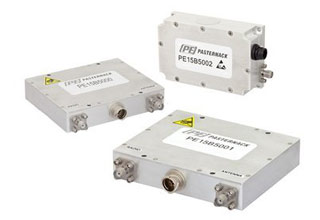
pasternackpr-150922Pasternack, a manufacturer and supplier of RF, microwave and millimeter wave products, introduces a new line of bi-directional amplifiers that are used for sending and receiving radio signals in key applications such as unmanned aerial vehicles (UAV), unmanned ground vehicles, L and S band radar, military radio, commercial air traffic control, weather and earth observation, satellites and high gain driver power amplifiers.

The new bi-directional RF amplifiers from Pasternack consist of 2 narrow band models that operate in L-Band (1.35 to 1.39 GHz) and S-Band (2.4 to 2.5 GHz). These designs utilize highly linear Class AB LDMOS semiconductor technology. A general purpose broadband model is also featured which covers 30 MHz to 3 GHz and uses Class A GaAs semiconductors. Typical gain levels for these amplifiers range from 20 to 23 dB with ±0.5 dB gain flatness. The key advantage of these designs is fast switching capability (1 microsecond typical) between Transmit (Tx) and Receive (Rx) states where high output power is generated, while at the same time, the sensitive receiver section has a 2.5 dB noise figure and sufficient RF gain levels to maintain a high data rate link.

These models are designed for use in both military and commercial applications and are capable of supporting any signal type and modulation format, including but not limited to 3-4G telecom, WLAN, OFDM, DVB and CW/AM/FM. The company’s bi-directional amplifiers utilize the latest technologies and design methods that offer high power density, efficiency and linearity in small lightweight environmentally sealed packages with SMA connectors. These modules also feature a quick-connect circular locking connector for DC and control functions. All designs use a single voltage supply with voltage regulation.

“Pasternack’s selection of in-stock bi-directional amplifiers exhibit fast transmit and receive switching capabilities, long transmission range and highly efficient operation which are critical for use in applications such as unmanned aerial vehicles and cellular networks,” explains Tim Galla, Active RF Components Product Manager at Pasternack.

Pasternack’s broadband bi-directional amplifiers are in-stock and ready to ship. You can view these components by visiting http://www.pasternack.com/pages/Featured_Products/coaxial-packaged-bi-directional-amplifiers.htm.

Pasternack
http://www.pasternack.com

Filed Under: Amplifiers Tagged With: pasternack

Reader Interactions

Leave a Reply Cancel reply

You must be logged in to post a comment.

Primary Sidebar

Featured Contributions

High-Performance GPUs Are Located in a Variety of Environments, including Data Center Racks.

AI’s demand for faster, more reliable IC testing

Design a circuit for ultra-low power sensor applications

Active baluns bridge the microwave and digital worlds

Managing design complexity and global collaboration with IP-centric design

PCB design best practices for ECAD/MCAD collaboration

More Featured Contributions

EE TECH TOOLBOX

“ee
Tech Toolbox: Sensors
In this Tech Toolbox, we cover some of those technologies driving the next generation of connected systems, including ultra-low-power sensing strategies that extend node battery life, and 60 GHz CMOS radar for contactless health and presence detection.

EE LEARNING CENTER

EE Learning Center
“analog
EXPAND YOUR KNOWLEDGE AND STAY CONNECTED
Get the latest info on technologies, tools and strategies for EE professionals.

EE ENGINEERING TRAINING DAYS

engineering

RSS Current EDABoard.com discussions

  • Understanding simple driver schematic
  • Calculating the ripple current for a capacitor in a vfd
  • I2C Read rules
  • Python script for SPI bridge
  • May I ask: Is it possible to encounter such issues or customer demands as below in reality?

RSS Current Electro-Tech-Online.com Discussions

  • Using capacitance meter to fix broken cables
  • Why aren’t the power windows in my 2006 Volkswagen Polo 2006 working despite repairing the control unit circuit board?
  • Relay question
  • Battery discharger
  • Difference between TTL, RS232 and RS485
“bills

Footer

Analog IC Tips

EE WORLD ONLINE NETWORK

  • 5G Technology World
  • EE World Online
  • Engineers Garage
  • Battery Power Tips
  • Connector Tips
  • EDA Board Forums
  • Electro Tech Online Forums
  • EV Engineering
  • Microcontroller Tips
  • Power Electronic Tips
  • Sensor Tips
  • Test and Measurement Tips

ANALOG IC TIPS

  • Subscribe to our newsletter
  • Advertise with us
  • Contact us
  • About us

Copyright © 2026 · WTWH Media LLC and its licensors. All rights reserved.
The material on this site may not be reproduced, distributed, transmitted, cached or otherwise used, except with the prior written permission of WTWH Media.

Privacy Policy
