• Skip to primary navigation
  • Skip to main content
  • Skip to primary sidebar
  • Skip to footer

Analog IC Tips

Analog IC Design, Products, Tools Layout

  • Products
    • Amplifiers
    • Clocks & Timing
    • Data Converters
    • EMI/RFI
    • Interface & Isolation
    • MEMS & Sensors
  • Applications
    • Audio
    • Automotive/Transportation
    • Industrial
    • IoT
    • Medical
    • Telecommunications
    • Wireless
  • Learn
    • eBooks / Tech Tips
    • FAQs
    • EE Learning Center
    • EE Training Days
    • Tech Toolboxes
    • Webinars & Digital Events
  • Resources
    • Design Guide Library
    • Digital Issues
    • Engineering Diversity & Inclusion
    • LEAP Awards
    • Podcasts
    • White Papers
  • Video
    • EE Videos
    • Teardown Videos
  • EE Forums
    • EDABoard.com
    • Electro-Tech-Online.com
  • Engineering Training Days
  • Advertise
  • Subscribe

Phased-array antennas optimized for satellites, space vehicles

August 17, 2021 By Redding Traiger Leave a Comment

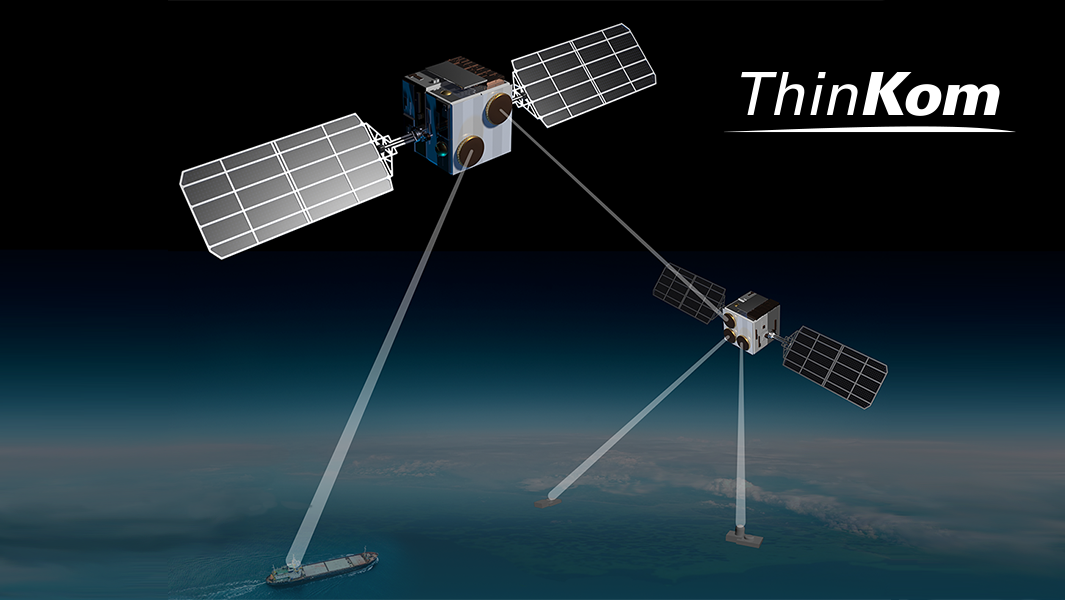
ThinKom Solutions announced the development of a new family of phased-array antennas for deployment on satellites and other space vehicles.

The antennas are based on ThinKom’s proven VICTS (Variable Inclination Continuous Transverse Stub) technology. The multi-frequency full-duplex antennas are designed for operation on geostationary and non-geostationary satellites using C-, X-, Ku-, Ka-, Q-, V-, E- and W-band frequencies. They can provide steerable high-capacity inter-satellite links as well as space-to-earth and Earth-to-space feeders and useful links.

The new ThinKom payload antennas are compact and lightweight, with a 30-cm diameter antenna weighing less than 5 kg. They can be nested for multi-beam applications without the blockages that can occur with multiple parabolic dish arrays. They can also support digital beamforming within regional user beams.

The space payload VICTS antennas are designed with an aluminum structure and space-compatible components to function reliably under extreme conditions of radiation, shock, vibration, and temperature. The compact highly reliable conformal arrays do not require any post-launch deployment mechanisms, eliminating the added weight and complexity of traditional satellite antenna systems.

The high-efficiency VICTS antenna architecture enables a smaller mounting size and volume for a given level of performance, as well as lower inertia than traditional satellite designs. The result is extremely low power consumption, a critical requirement for space applications.

Other key features include 80-degree scan angle coverage, wide instantaneous channel bandwidth up to 2 GHz, polarization diversity, low sidelobe emissions, and continuous jitterless high-agility scanning.
You may also like:

  • PIM setup
    What is passive intermodulation?
  • impedance
    VSWR and impedance, Part 2: Reflected power
  • VSWR and impedance
    The basics of VSWR and impedance: part 1

  • What is second-generation beamforming and digital beamforming?

  • Metamaterials, mmWave antennas, 3D radar and holographic beamforming

Filed Under: Aerospace & Defense, antennas, Applications, Automotive/Transportation, Products, Tools Tagged With: thinkomsolutionsinc

Reader Interactions

Leave a Reply Cancel reply

You must be logged in to post a comment.

Primary Sidebar

Featured Contributions

High-Performance GPUs Are Located in a Variety of Environments, including Data Center Racks.

AI’s demand for faster, more reliable IC testing

Design a circuit for ultra-low power sensor applications

Active baluns bridge the microwave and digital worlds

Managing design complexity and global collaboration with IP-centric design

PCB design best practices for ECAD/MCAD collaboration

More Featured Contributions

EE TECH TOOLBOX

“ee
Tech Toolbox: Sensors
In this Tech Toolbox, we cover some of those technologies driving the next generation of connected systems, including ultra-low-power sensing strategies that extend node battery life, and 60 GHz CMOS radar for contactless health and presence detection.

EE LEARNING CENTER

EE Learning Center
“analog
EXPAND YOUR KNOWLEDGE AND STAY CONNECTED
Get the latest info on technologies, tools and strategies for EE professionals.

EE ENGINEERING TRAINING DAYS

engineering

RSS Current EDABoard.com discussions

  • Understanding simple driver schematic
  • Calculating the ripple current for a capacitor in a vfd
  • I2C Read rules
  • Python script for SPI bridge
  • May I ask: Is it possible to encounter such issues or customer demands as below in reality?

RSS Current Electro-Tech-Online.com Discussions

  • Using capacitance meter to fix broken cables
  • Why aren’t the power windows in my 2006 Volkswagen Polo 2006 working despite repairing the control unit circuit board?
  • Relay question
  • Battery discharger
  • Difference between TTL, RS232 and RS485
“bills

Footer

Analog IC Tips

EE WORLD ONLINE NETWORK

  • 5G Technology World
  • EE World Online
  • Engineers Garage
  • Battery Power Tips
  • Connector Tips
  • EDA Board Forums
  • Electro Tech Online Forums
  • EV Engineering
  • Microcontroller Tips
  • Power Electronic Tips
  • Sensor Tips
  • Test and Measurement Tips

ANALOG IC TIPS

  • Subscribe to our newsletter
  • Advertise with us
  • Contact us
  • About us

Copyright © 2026 · WTWH Media LLC and its licensors. All rights reserved.
The material on this site may not be reproduced, distributed, transmitted, cached or otherwise used, except with the prior written permission of WTWH Media.

Privacy Policy