
 It is theoretically possible to solve Maxwell’s equations to characterize how an RF signal propagates some distance away from its transmitter, but that task is impossibly complex for most real applications. That’s why the usual ways of analyzing the propagation of RF signals, as used in cellular and other communication systems, is to rely on approximations and measurements made under various conditions.
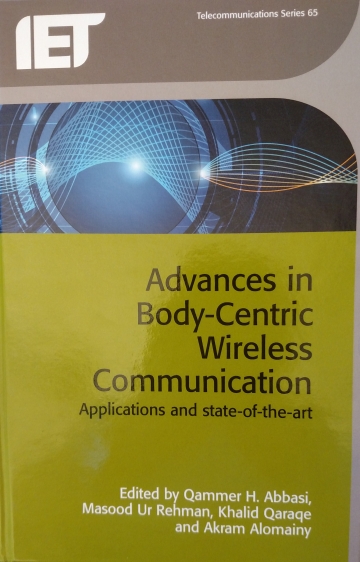
The same can be said for the communication signals involved in wearable electronics; today, gauging the strength and other qualities of signals in body-centric systems is largely an empirical exercise. This reality illustrates the value of a recently published book called Advances in Body-Centric Wireless Communication, edited by Qammer H. Abbasi, Masood Ur-Rehman, Khalid Qaraqe, and Akram Alomainy.
The 437-page text targets developers and researchers working in wireless communication who are designing antennas and planning communication channels in the close proximity of human bodies. In the absence of this text, researchers would be forced to plow through a lot of published research to get the kind of transmission data they would need to field systems. Instead, the book authors have done that work, summarizing the results of numerous studies done in the frequency bands that pertain to body-centric RF. This volume is also particularly helpful in that the design of wearable electronics is too new to have found its way into textbooks. Thus summaries of research in the field is pretty much all that practitioners can hope to see in book form.
Among the topics the book authors cover are wide-band body-area networks and the benefits of diversity, basically relying on more than one network link for getting messages through. They also cover work done toward characterizing boy-centric wireless channels. Other sections of the book review recent advances and remaining challenges in how antennas interact with human bodies in the 60 GHz range, emphasizing interactions in the millimeter wave area.
The authors also get into ingestible electronics, covering the challenges and difficulties of fielding gastrointestinal capsules that incorporate antennas. A related chapter focuses on propagation of signals as found in in vivo sensors and actuators such as pacemakers and wireless capsule endoscopes. Researchers approach this area by modeling the human body’s electromagnetic properties, and the book spends a fair amount of time on how EM waves propagate through human tissues and on how to construct antennas for in vivo applications.
Other topics the text covers in detail include that of MIMO systems for on-body channels and on-body GPS antennas. GPS antenna scenarios consider different body postures and antenna positions on the body. MIMO discussions pertain to high data rates and the potential from MIMO methods to cancel co-channel interference.
The book also gets into what happens when waveguides are integrated with textile substrates, describing both the state-of-the-art and the direction of work done for next-generation systems. The authors cover both experimental and numerical studies done on how antennas behave placed at different locations on the body. The book even gets to nano-scale communications done at terahertz frequencies, and as well looks at future directions for body area networks.
All in all, the book should be a valuable resource for those planning and creating wearable electronics that involve sending and receiving RF signals.
Advances in Body-Centric Wireless Communication, edited by Qammer H. Abbasi, Masood Ur-Rehman, Khalid Qaraqe, and Akram Alomainy, published by the Institution of Engineering and Technology, London, UK, ISBN 978-1-84919-989-6 (hardback), ISBN 978-1-84919-990-2 (PDF)
