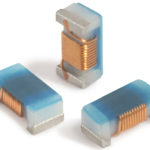
 AVX Corporation released a new series of ultraminiature multilayer ceramic chip inductors for high-frequency RF applications. The new LCCI Series inductors are currently available in three standard EIA chip sizes — 0201, 0402, and 0603 — with tight-tolerance physical dimensions almost exclusively in the submillimeter range and tin-plated surface-mount terminations, enabling compatibility with high-density PCBs and reflow soldering in space- and weight-constrained applications within the telecommunications and networking markets, as well as with lead-free and RoHS directives. The series also delivers outstanding reliability and performance from 100MHz to 2.4GHz, exhibiting high Q, high signal efficiencies, low DC resistance (DCR), tight inductance tolerances down to ±0.1nH, and guaranteed self-resonant frequencies (SRF) up to 10GHz. Ideal applications include mobile communications and computer networking systems, wireless large-area networks (WLAN), radio-frequency identification (RFID) systems, personal handheld systems (PHS) ranging from smartphones and tablets to media players and gaming devices, and EMI countermeasures in high-frequency circuits.
LCCI Series ultraminiature multilayer ceramic chip inductors are rated for use in operating temperatures spanning -40°C to +85°C and are available with three standard inductance values: 3.9nH, 39nH, and 390nH and seven standard inductance tolerances: 2%, 3%, 5%, 10%, 0.1nH, 0.2nH, 0.3nH. Inductance values for 0201 parts extend from 0.3nH to 39nH with inductance tolerances ranging from ±0.1nH to ±5% and minimum SRF values spanning 1,500MHz to 10,000MHz. Inductance values for 0402 parts extend from 0.3nH to 150nH with inductance tolerances ranging from ±0.1nH to ±5% and minimum SRF values spanning 550MHz to 10,000MHz. Inductance values for 0603 parts extend from 1.0nH to 470nH with inductance tolerances ranging from ±0.3nH to ±5% and minimum SRF values spanning 300MHz to 10,000MHz.
The series is also competitively priced, packaged on tape and reel, compatible with pick-and-place processing equipment, and currently available with a 12-week lead-time.