
• Skip to primary navigation
  • Skip to main content
  • Skip to primary sidebar
  • Skip to footer

Analog IC Tips

Analog IC Design, Products, Tools Layout

  • Products
    • Amplifiers
    • Clocks & Timing
    • Data Converters
    • EMI/RFI
    • Interface & Isolation
    • MEMS & Sensors
  • Applications
    • Audio
    • Automotive/Transportation
    • Industrial
    • IoT
    • Medical
    • Telecommunications
    • Wireless
  • Learn
    • eBooks / Tech Tips
    • FAQs
    • EE Learning Center
    • EE Training Days
    • Tech Toolboxes
    • Webinars & Digital Events
  • Resources
    • Design Guide Library
    • Digital Issues
    • Engineering Diversity & Inclusion
    • LEAP Awards
    • Podcasts
    • White Papers
  • Video
    • EE Videos
    • Teardown Videos
  • EE Forums
    • EDABoard.com
    • Electro-Tech-Online.com
  • Engineering Training Days
  • Advertise
  • Subscribe

Specialty compound addresses stringed demands of BiTS used to stress test

November 30, 2022 By Redding Traiger Leave a Comment

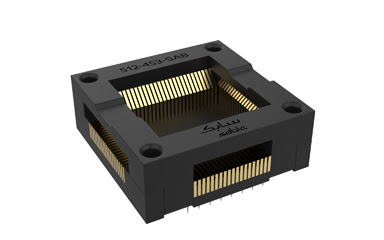
SABIC introduced the LNP KONDUIT 8TF36E compound, a new specialty material that helps address the stringent demands of burn-in test sockets (BiTS) used to stress-test double-data-rate (DDR) memory integrated circuits (ICs). As the number of pins and the testing temperature for DDR ICs increase and their dimensions shrinks, materials used in BiTS components must deliver enhanced properties. SABIC’s new compound provides very high flow to help enable complex, miniaturized BiTS designs; excellent dimensional stability and high-temperature resistance to enhance BiTS functionality during testing, and high thermal conductivity to rapidly dissipate heat afterward.
Compared to incumbent materials such as thermally conductive-filled nylon, the LNP KONDUIT 8TF36E compound delivers higher flow and better dimensional stability. Customers could benefit from using this new material, which can potentially address the full range of their requirements.
Double-data-rate memory ICs, which fetch data twice per processor clock cycle, accelerate data transfer to meet the high throughput demands of gaming, artificial intelligence, and other data-intensive applications. This technology is putting greater pressure on test socket manufacturers, whose products must accommodate higher voltages, higher-temperature environments, ever-smaller form factors, and an increased number of pins. For these reasons, BiTS designs for DDR ICs require high precision, high durability, and workability.
LNP KONDUIT 8TF36E compound features high flow to help enable miniaturized and complicated designs with many pinpoints. During the testing process, it can easily withstand typical testing temperatures of 150°C while maintaining good dimensional stability to help improve the accuracy of measurements. This high heat capacity can potentially permit BiTS to be re-used repeatedly without degrading. Further, the LNP KONDUIT 8TF36E compound can handle extreme temperatures up to 260°C, building in the capability to address higher-heat BiTS requirements in the future. Finally, to quickly dissipate heat after testing, the new product provides high thermal conductivity of up to 4.5W/m.k.
The new SABIC compound is well suited for fixed, structural parts, including latches and adaptors, in BiTS assemblies.
The New LNP KONDUIT 8TF36E compound is globally available.

You may also like:


  • What materials can be used to make miniature antennas?

  • Optical links for spacecraft, Part 2: projects and progress

  • Optical links for spacecraft, Part 1: The throughput limitation

  • Keeping the noise down

  • What is common-impedance coupling?

Filed Under: Analog ICs, Products, Tools Tagged With: sabic

Reader Interactions

Leave a Reply Cancel reply

You must be logged in to post a comment.

Primary Sidebar

Featured Contributions

High-Performance GPUs Are Located in a Variety of Environments, including Data Center Racks.

AI’s demand for faster, more reliable IC testing

Design a circuit for ultra-low power sensor applications

Active baluns bridge the microwave and digital worlds

Managing design complexity and global collaboration with IP-centric design

PCB design best practices for ECAD/MCAD collaboration

More Featured Contributions

EE TECH TOOLBOX

“ee
Tech Toolbox: Sensors
In this Tech Toolbox, we cover some of those technologies driving the next generation of connected systems, including ultra-low-power sensing strategies that extend node battery life, and 60 GHz CMOS radar for contactless health and presence detection.

EE LEARNING CENTER

EE Learning Center
“analog
EXPAND YOUR KNOWLEDGE AND STAY CONNECTED
Get the latest info on technologies, tools and strategies for EE professionals.

EE ENGINEERING TRAINING DAYS

engineering

RSS Current EDABoard.com discussions

  • Understanding simple driver schematic
  • Calculating the ripple current for a capacitor in a vfd
  • I2C Read rules
  • Python script for SPI bridge
  • May I ask: Is it possible to encounter such issues or customer demands as below in reality?

RSS Current Electro-Tech-Online.com Discussions

  • Using capacitance meter to fix broken cables
  • Why aren’t the power windows in my 2006 Volkswagen Polo 2006 working despite repairing the control unit circuit board?
  • Relay question
  • Battery discharger
  • Difference between TTL, RS232 and RS485
“bills

Footer

Analog IC Tips

EE WORLD ONLINE NETWORK

  • 5G Technology World
  • EE World Online
  • Engineers Garage
  • Battery Power Tips
  • Connector Tips
  • EDA Board Forums
  • Electro Tech Online Forums
  • EV Engineering
  • Microcontroller Tips
  • Power Electronic Tips
  • Sensor Tips
  • Test and Measurement Tips

ANALOG IC TIPS

  • Subscribe to our newsletter
  • Advertise with us
  • Contact us
  • About us

Copyright © 2026 · WTWH Media LLC and its licensors. All rights reserved.
The material on this site may not be reproduced, distributed, transmitted, cached or otherwise used, except with the prior written permission of WTWH Media.

Privacy Policy