by Ken Ghadia, Sales Engineer, TechnoTronix
 The introduction of Artificial Intelligence (AI) in PCB manufacturing has largely improved the product quality, optimized the production process, and significantly reduced the manufacturing cost. AI drives independent automation of PCB production by using the vast data aggregated from several sensors. Machine learning and deep learning are the AI sub-domains used to analyze and interpret the accumulated data, which in turn are used to improve the PCB efficiency and production yield.
The advantages of using AI in the PCB manufacturing industry are immense. It can offer enhanced PCB performance, reduced production cost, quick assembly turnaround, excellent material management, minimized scrap wastes, improved system communication, inspection and debugging assistance, etc. In short, with AI, you can easily provide turnkey PCB assembly. The ability of AI to provide real-time troubleshooting support can save both time and money for PCB manufacturers.
AI in PCB design
Electronic design automation (EDA) tools are used in PCB circuit and layout designs. With the increasing design complexities and requirements for a quick product-to-market timeline, integration of AI in the EDA tools have made the job easy for PCB designers. AI-enabled auto-routers can efficiently route high-frequency signals in multi-layer PCBs. They learn from previous design examples and build from human intelligence.
Some of the methods through which AI is bringing progress in PCB manufacturing are as follows:
- AI can design circuits faster than humans and manufacture PCBs earlier than the traditional method. This provides better output and higher product quality.
- AI-based optical inspection uses computer vision equipment with machine learning capabilities to capture 2D/3D images. To detect errors, pattern recognition algorithms compare the captured image against a reference image. Rapid fault detection can speed up the rework of PCB and reduce the overall production cost.
- AI-assisted soldering machines are highly productive in soldering fine-pitch integrated circuits (ICs). They use nozzles to solder tiny parts at a very high temperature.
- Smart sensors are used to capture numerous data during the PCB fabrication process. The captured data is analyzed to identify error-prone areas in the process flow. This is known as predictive maintenance, which reduces the assembly line downtime and avoids impending losses.
Reliable and accurate PCBs are produced using an AI-enabled PCB manufacturing process. The effective results boost the sales of PCB products. The vast data collected in an AI-driven system should be carefully evaluated to use it best.
Integrating AI into PCB manufacturing can be highly beneficial, but it is necessary to consider some of the key factors:
- Examine the data to be accurate as it is used further in analysis and strategy planning. Using accurate data inputs can assist the automation software in exact fault detection.
- The AI-based output will be more precise if more data is collected from the production line for analysis.
- Expertise in AI and PCB manufacturing is critical to achieving the best results. The enormous data captured can confuse the operator if not understood properly.
- Research and continuous improvement are essential to accomplish the full potential of AI in PCB manufacturing. Deep learning and Machine learning can assure minimal human intervention in the production process, reducing errors.
AI may not replace the manual workforce in PCB factories. Instead, it will assist human intelligence in achieving higher efficiency and improving performance.
AI implementation at system-level
AI integration in PCB production can greatly impact the yield. Machine learning will significantly reduce human error in fault detection like opens, shorts, excess copper in the trace, etc. Automated inspection can capture small errors that may be overlooked in manual inspection due to fatigue or task repetitions.
Inspection of PCBs is one of the critical stages that can be profited by adopting AI. It enables the accurate detection of millions of defects. Machine learning on an Automated Optical Inspection system will reduce false alarms and debugging required during the PCB assembly. Also, the correct classification of faults can streamline the testing of PCB needed and the rework process.
Industry 4.0 with AI
Industry 4.0 is the latest manufacturing revolution focusing on automation, machine learning, real-time data, and interconnectivity. Every business organization involved in manufacturing is looking for connectivity and access to live data insights across several processes and products. Industry 4.0 is the standard that offers techniques to improve manufacturing efficiency. It provides data visibility enabling a better understanding of supply chain management. The asset tracking and ability to predict any potential snags are the features of the Industry 4.0 standard that are enabled by AI technology. Deep learning is used to analyze and self-learn the process, which can eliminate human intervention in a few years.
With the help of Industry 4.0 sensors, data is collected throughout the manufacturing process, which can be parameters like chemical concentration, imaging on copper-clad laminate, mounting hole size, etc. These data are evaluated using deep learning to infer the quality of PCB fabrication and assembly.
AI improves fabrication processes and reduces manual operations by effectively handling inventory and assets of the PCB factories. Deep learning can learn from the data patterns and interpret the insights to improve the quality of PCB manufacturing. AI in PCB production has brought huge growth by logically improving the industry models to optimize operations. Analyses of data collected from the processes lead to innovative ideas in PCB design and manufacturing.
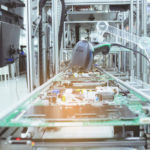
Due to technical challenges, the complete automation of PCB factories is not yet accomplished. But AI is currently included in standalone systems like automated optical inspection (AOI) equipment. The AI-enabled inspection system can detect PCB faults and trace them back to the source. The loopback system can automate corrections for such faults and minimize further defects.
Conclusion
The manufacturing challenges adversely impact many fault detection techniques used in PCB production. Shrinking trace widths in compact designs, miniature components, and flexible substrates increase the possibility of false alarms. The HDI PCBs used in 5G applications require intricate layout design, which can be extremely difficult for manual routing. AI-driven PCB designs can proficiently handle critical trace routings within strict margins. Meeting the quality standards becomes easy with the implementation of AI in the PCB manufacturing process. AI also assists in predicting future product demands. System-level AI has already brought tremendous progress in PCB manufacturing. Going ahead, factory-level AI automation will completely revolutionize PCB productions.