
• Skip to primary navigation
  • Skip to main content
  • Skip to primary sidebar
  • Skip to footer

Analog IC Tips

Analog IC Design, Products, Tools Layout

  • Products
    • Amplifiers
    • Clocks & Timing
    • Data Converters
    • EMI/RFI
    • Interface & Isolation
    • MEMS & Sensors
  • Applications
    • Audio
    • Automotive/Transportation
    • Industrial
    • IoT
    • Medical
    • Telecommunications
    • Wireless
  • Learn
    • eBooks / Tech Tips
    • FAQs
    • EE Learning Center
    • EE Training Days
    • Tech Toolboxes
    • Webinars & Digital Events
  • Resources
    • Design Guide Library
    • Digital Issues
    • Engineering Diversity & Inclusion
    • LEAP Awards
    • Podcasts
    • White Papers
  • Video
    • EE Videos
    • Teardown Videos
  • EE Forums
    • EDABoard.com
    • Electro-Tech-Online.com
  • Engineering Training Days
  • Advertise
  • Subscribe

Improving transimpedance amplifiers with a bootstrap

April 26, 2021 By Chris Francis Leave a Comment

Analog bootstrap circuits are traditionally ones where output is fed back to the input, usually to increase input impedance. This can be to minimize either the resistive or reactive (usually capacitive) components of the input impedance or both. The term is now also used with MOSFET drivers where a capacitor is charged and used to pump up a voltage for gate drive. This article is concerned with reducing the effect of the gate-drain capacitance of a JFET in a transimpedance amplifier. The technique can also be used for bipolar circuits or HEMT or GaAsFET transistors and can be extended to also reduce the effects of photodiode capacitance.

A typical idealized JFET input transimpedance amplifier could be represented like this:

 transimpedance amplifiers

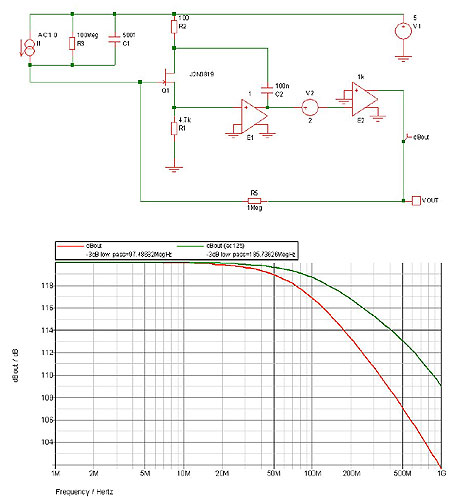
I1, R3 and C1 represent the photodiode with some dark current (leakage) and 0.5pF of capacitance. The JFET is shown as a source follower with an ideal gain stage E2 following it. V2 is used to level shift for biasing. This arrangement would give around 96MHz of bandwidth. One reason for using a source follower for the first stage rather than a common source amplifier is that you will need a unity gain stage for bootstrapping but also because the source follower will have a wider bandwidth than a common source amplifier. The disadvantage is that the noise performance of a common source based circuit is likely to be better than one based on a source follower.

Adding a bootstrap as shown below will roughly double the bandwidth to 183MHz.
Analog

The bootstrapping can be further extended to include the photodiode. This can be particularly helpful where the photodiode has a large capacitance.

Analog

For example, with 5pF of photodiode capacitance, bootstrapping the JFET has very little effect because the input capacitance is dominated by the photodiode not the JFET. However, bootstrapping the photodiode will increase the bandwidth from 24MHz to 81MHz. Then bootstrapping the JFET will further increase that to 130MHz because the effective photodiode capacitance has been reduced and the JFET gate-drain capacitance is significant again. Bootstrapping the JFET on its own will only increase the bandwidth from 24MHz to 27MHz. Real-life circuits will not be quite as good depending on how they are implemented.

The unity gain buffer required for the bootstrap might be implemented with an emitter follower in which case its gain will be less than unity. However, if an opamp were used then the performance would be better. Similarly, the gain stage will not have infinite bandwidth. Overall though, the technique is very useful in trying to design high transimpedance, high bandwidth transimpedance amplifiers for photodiodes, including avalanche photodiodes. The techniques can be used with custom IC-based implementations as well as discrete circuits, and for circuits with discrete devices mixed with opamps.

As with any circuit of this nature, the circuit noise should also be analyzed as well, and transient simulations carried out to check there are no undesirable effects under certain circumstances/conditions. This would include the effect of a significant DC current in the photodiode if that was a possible operating condition for the circuit.

You may also like:


  • Photodiode: light sources, the amount of light, and color

Filed Under: Amplifiers, FAQ, Featured, Industry Experts, Products Tagged With: basics, FAQ

Reader Interactions

Leave a Reply Cancel reply

You must be logged in to post a comment.

Primary Sidebar

Featured Contributions

High-Performance GPUs Are Located in a Variety of Environments, including Data Center Racks.

AI’s demand for faster, more reliable IC testing

Design a circuit for ultra-low power sensor applications

Active baluns bridge the microwave and digital worlds

Managing design complexity and global collaboration with IP-centric design

PCB design best practices for ECAD/MCAD collaboration

More Featured Contributions

EE TECH TOOLBOX

“ee
Tech Toolbox: Power Electronics
Our latest eBook compiles essential technical articles covering freewheeling diodes, snubber circuits, coreless transformers in solid-state isolators, PWM current source converters, hot-swap implementation, inrush current analysis, and inverter switching strategies for battery longevity.

EE LEARNING CENTER

EE Learning Center
“analog
EXPAND YOUR KNOWLEDGE AND STAY CONNECTED
Get the latest info on technologies, tools and strategies for EE professionals.

EE ENGINEERING TRAINING DAYS

engineering

RSS Current EDABoard.com discussions

  • Is it possible to achieve this in Comparator?
  • Pliers for eletctronics repairs
  • Help with rs232 and can
  • Thermaltake psu TR2600L2NC
  • Question power soldering iron damage pcb and smd components

RSS Current Electro-Tech-Online.com Discussions

  • Raise your hand if your car had one of these:
  • MCS-51 Development Ecosystem
  • ESP32 Sub Forum
  • Please could you advise me on this circuit for car OBD2
  • Mitsubishi projection lamp
“bills

Footer

Analog IC Tips

EE WORLD ONLINE NETWORK

  • 5G Technology World
  • EE World Online
  • Engineers Garage
  • Battery Power Tips
  • Connector Tips
  • EDA Board Forums
  • Electro Tech Online Forums
  • EV Engineering
  • Microcontroller Tips
  • Power Electronic Tips
  • Sensor Tips
  • Test and Measurement Tips

ANALOG IC TIPS

  • Subscribe to our newsletter
  • Advertise with us
  • Contact us
  • About us

Copyright © 2026 · WTWH Media LLC and its licensors. All rights reserved.
The material on this site may not be reproduced, distributed, transmitted, cached or otherwise used, except with the prior written permission of WTWH Media.

Privacy Policy